In the world of interfaith relations, major anniversaries don’t always get the attention they deserve. Many readers will know that 2025 marked the 60th anniversary of Nostra Aetate, the groundbreaking Vatican II document that reset the Catholic Church’s relationship with Judaism and other religions.
Far fewer know what happened next.
Just five years later, in 1971, for the first time in history, world Jewry entered into formal relations with the Vatican. To make that possible, Jewish organizations around the world created a new body: the International Jewish Committee for Interreligious Consultations (IJCIC) — a consortium representing the Orthodox, Conservative, and Reform movements, along with major Jewish organizations such as the American Jewish Committee, the World Jewish Congress, ADL, B’nai B’rith, and others. IJCIC remains the official Jewish interlocutor not only with the Vatican, but with other major world religious bodies today.
And then something else happened that even fewer people know about.
A Unique Relationship Takes Shape
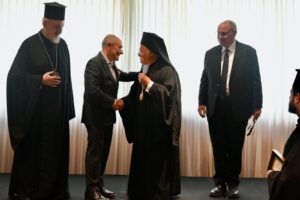
Fifty years ago, under the leadership of the Ecumenical Patriarch, the Christian Orthodox churches formally established relations with world Jewry through IJCIC as well. That bilateral relationship quietly reached its 50-year milestone this year — and in December was celebrated at a gathering in Geneva.
This meeting, attended and addressed by Ecumenical Patriarch Bartholomew, focused on a compelling theme: “Sanctity of Place; Sanctity of Space.”
Discussions ranged widely, including the ways sacred geography shapes power, identity, and spirituality — and how sanctity extends far beyond official houses of worship.
Over the decades, many such meetings have taken place. What makes this particular dialogue noteworthy is not only its longevity, but the spirit in which it has unfolded.
Not a Dialogue Born of Crisis
Unlike many Christian–Jewish dialogues, the Orthodox–Jewish engagement did not begin as an attempt to resolve historic grievances or doctrinal wounds. Nor was it fueled by geopolitical necessity or pressure.
It began simply because both communities recognized something in one another.
Both have lived as majorities and minorities across centuries and continents. Both place deep emphasis on liturgy, scripture, commentary, and tradition. Both have internal diversity shaped by diaspora experience, resulting in distinct liturgical cultures and interpretive schools.
Perhaps most importantly: the dialogue has never been a theological sparring match. Its purpose is educational and relational — built on mutual respect, not apologetics.
Trust Is Not an Accessory — It’s the Work
As participants often note, one of the distinguishing features of this bilateral dialogue is the degree of trust among the delegates. Jewish and Christian Orthodox representatives plan together, learn together, and teach together. Delegations include a range of political and ideological viewpoints, offering a window into the complexity within each faith — not just across them.
Such trust is not automatic. It is cultivated over years of conversation, shared meals, disagreements, clarifications, and intellectual curiosity. Participants in Geneva represented 19 countries — some veterans of these dialogues, others experiencing such engagement for the first time. That mix served as a reminder that interreligious learning is never finished, never self-executing, and never something to be taken for granted.
But Does Anything Actually Come From These Meetings?
It’s a fair and frequently asked question. Senior-level dialogues often operate at what observers call the “30,000-foot level,” involving patriarchs, rabbis, theologians, scholars, and organizational leaders. Real change at the congregational or local level can take time.
And yet, tangible results exist.
A joint document on “teaching about the other,” produced more than 20 years ago by IJCIC and the Vatican, is now both official Church policy and a resource used in Jewish educational settings around the world. Significant misunderstandings have been addressed directly because channels for communication — and relationships — existed. When crises arise, leaders know whom to call.
Perhaps the most consequential impact is quieter: senior leaders of many world religious bodies today are more open to the validity of other religious traditions than many of their own co-religionists. That shift did not emerge spontaneously; it emerged from decades of conversation, trust, and institutional cooperation.
Carrying the Work Forward
In recent years, the dialogue has also taken up a new responsibility: how to share what has been learned more broadly. A jointly authored educational document for seminaries, clergy, and congregations is now underway. Joint presentations have been offered at international interfaith conferences. Articles have been published to make the history and substance of this dialogue more accessible.
Is it enough? Not yet. But it represents movement — and in interreligious work, sustained movement over decades is no small thing.
Why This Matters Now
No one involved in these dialogues labors under the illusion that senior-level interfaith conversations can solve all interreligious challenges. But the participants are united by a different conviction: Good has come from these efforts — and more good is possible.
In a fractured world, where suspicion and misinformation travel faster than trust, the existence of fifty years of Jewish-Orthodox dialogue is itself a quiet but remarkable fact. It reminds us that religious communities can work not only to repair the past, but to imagine a wiser shared future.
This is interfaith work at its best — not only symbolic and diplomatic, but relational, durable, and committed to mutual education across generations.
A 50-year conversation, still underway.
By: Rabbi Richard Marker, Chair Emeritus, IJCIC, and Past Chair, Elijah Board of World
Religious Leaders
Mirele Goldsmith, Ph. D, IJCIC Conference Delegate, and Co-Founder, Jewish
Earth Alliance
Rabbi Richard Marker and Mirele Goldsmith are based in Bethesda, MD